
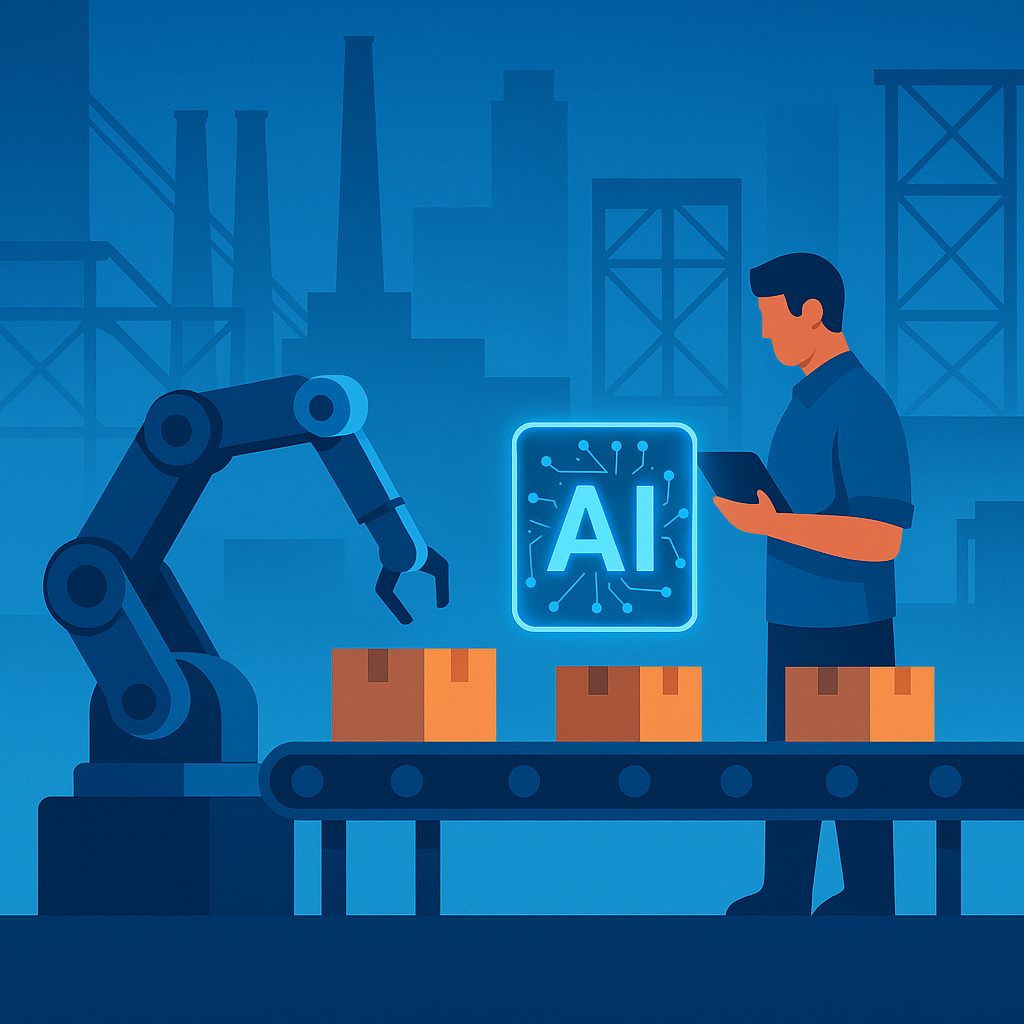
Manufacturing Industries Can Utilize AI? Strategies for AI Application in Production Lines, Quality Control, and Technical Support
When we talk about AI, many people first think of office automation, content generation, or customer service chatbots. However, manufacturing is one of the sectors most likely to benefit significantly from AI technology.
With advancements in Large Language Models (LLM), Computer Vision (CV), and Edge Computing (Edge AI), AI is no longer just theoretical concepts but practical tools that can be integrated into production lines and maintenance processes.
How Can Manufacturing Use AI?
- Automatic Line Inspection: Utilizing image recognition systems for detecting defects and anomalies
- Equipment Failure Alerts: Combining sensor data with AI models to anticipate potential faults
- Safety Assistance in the Workplace: Identifying hazardous behaviors in work zones, automatically notifying staff on-site
- Quality Control Data Aggregation and Report Generation: Using AI to streamline large amounts of inspection data into files quickly
- Tech Support Q&A System: Natural language queries for Standard Operating Procedures (SOPs), maintenance records, material correspondence tables
Real-life Case Studies
- An electronics contract manufacturing company incorporated AI into its Surface Mount Technology (SMT) production line, resulting in a 20% increase in defect recognition efficiency and a significant decrease in human quality inspection workload.
- A factory introduced voice assistant to query maintenance manuals, leading to a 30% increase in repair efficiency and reducing the time it takes for new hires to get started by half.
- An industrial sector utilized AI to analyze daily production records, predicting delays and adjusting schedules accordingly.
Three Common Pitfalls in Integrating AI into Manufacturing
- Pitfall 1: "We don't have enough data for AI" → In reality, many machines record sensor data that has not been utilized effectively.
- Pitfall 2: "AI is an IT department's responsibility" → The manufacturing floor should be the frontline where AI should deeply penetrate.
- Pitfall 3: "Worries about system complexity and lack of local usage skills" → Interface design and training are key to successful integration.
Suggestions for Introducing AI into Manufacturing Processes
- Define clear scenarios (e.g., defect identification, SOP search)
- List available data sources and formats
- Select appropriate models and deployment methods (cloud, edge, private)
- Conduct small-scale proof-of-concept testing and field tests
- Implement education training and continuous optimization mechanisms
How NT Tech Assists Manufacturing Industries in Adopting AI?
NT Tech specializes in 'practical implementation', helping manufacturing industries to effectively use AI, rather than treating it as a demonstration project:
- Image detection model training and deployment (including hardware recommendations and edge deployment)
- Building a technical knowledge Q&A system that combines maintenance records, SOPs
- System integration across platforms (such as MES/ERP systems with AI models)
- Automation of data aggregation and report generation modules
- Field implementation support and operator training
AI is more than just high-tech; it's a tool for factory floor operations. Let us guide you on a path that truly saves time, labor, and reduces error rates.