
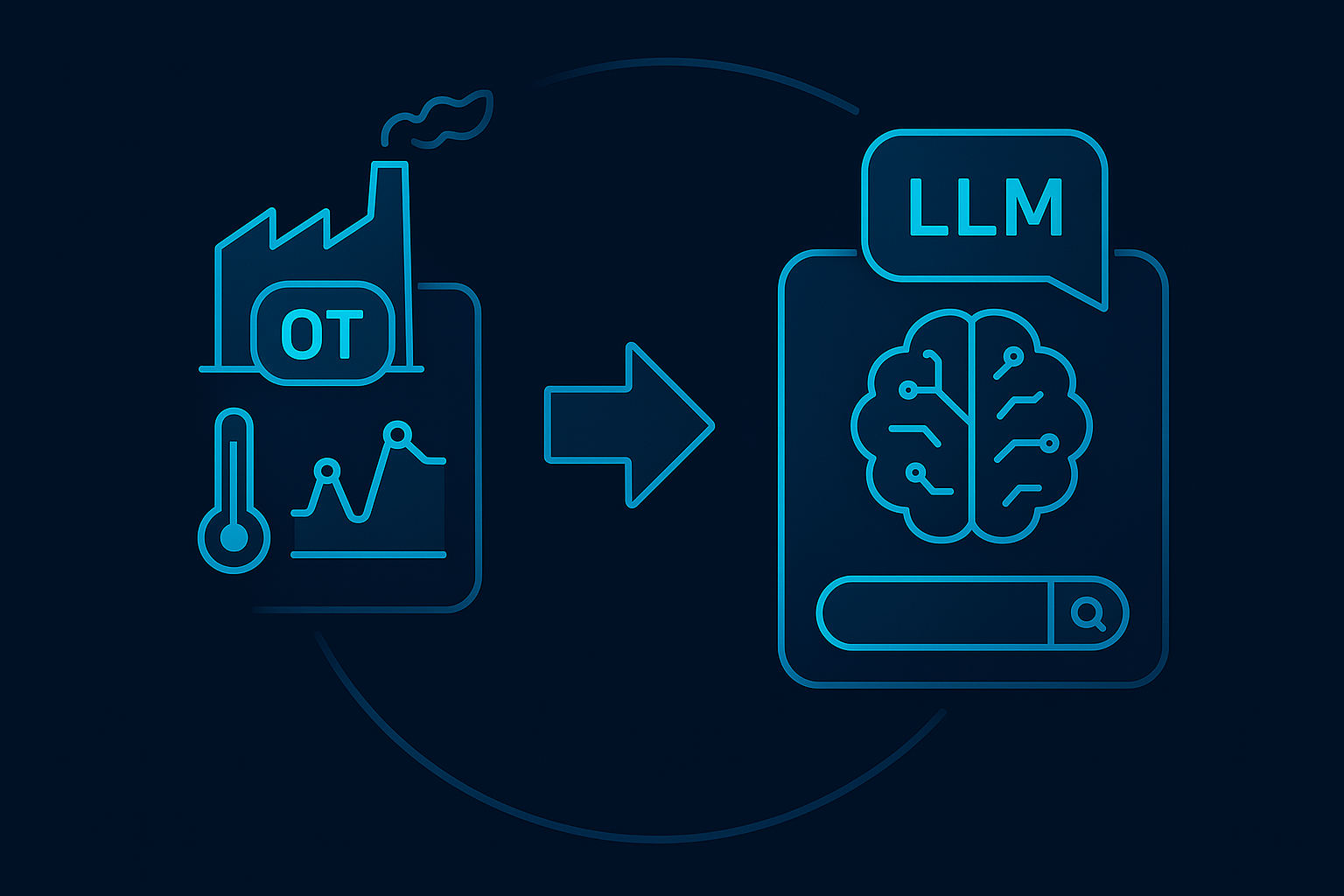
Factories also need language models? An OT Data & AI Bridging Guide
Talking about language models (LLMs), most people intuitively think of customer service, business, marketing. But in fact, the manufacturing industry is also entering the era of language models, especially those factories that have a large amount of OT (Operational Technology) data.
The problem is: There's never been a direct connection between OT data and LLMs. The two types of data are formatted differently, interpreted in different rhythms, and require bridges and designs for effective integration.
This article will guide you through the typical process of integrating OT data into language models, common challenges involved, as well as how AI can become a knowledge partner in smart manufacturing.
OT Data ≠ IT Data: LLMs Need to Interpret "Field Language"
OT data typically includes sensor data from machines, PLC signals, production line operations, and equipment anomaly records. The formats are usually:
- Value-time series
- Event-triggered & logical processes
- Synchronous status at multiple points
The strengths of language models lie in understanding text, semantics, instructions, summaries, and generation.
To make AI understand the "factory," you need a layer for "meaning translation." This involves converting raw OT data into descriptive content that language models can understand.
Typical Process: Five Steps from OT Data to Language Model
- Data Extraction: Retrieve data from OPC-UA, Modbus, and SCADA systems
- Event Marking: Establish Domain-Specific event semantics like "cooling anomaly" or "temperature surge"
- Semantic Wrapping: Convert multiple pieces of data into narrative sentences e.g., "A foundry machine experienced 3 consecutive high-pressure anomalies at 14:32."
- Embedding: Transform the narratives into language vectors for easy querying and response by the model
- Language Model Application: Use RAG architecture to have LLM answer questions like "What were the abnormalities last night?" or "Which machines had lower than standard stability this month?"
Challenges & Highlights: Why is this difficult?
Integrating OT data with language models comes with several typical challenges:
- Vocabulary Disparity: AI doesn't understand industrial jargon. It needs to be taught the specific language of each factory.
- Data Heterogeneity: There can be significant format differences between different machines and factories
- Context Importance: Machine anomalies are not point issues but results within a process node
- Edge-to-Cloud Collaboration: Some OT data cannot be directly moved to the cloud, requiring intermediary systems for transfer.
This isn't just an engineering issue; it's a challenge in knowledge modeling and semantic understanding as well.
NT Tech's Approach: Crafting AI Assistants that Speak "Manufacturing Language"
At NT Tech, we focus on private LLM solutions. When working with manufacturing industry clients, we often assist with tasks like:
- Building a semantic layer for OT data and establishing event classification logic
- Developing Prompt templates and RAG frameworks tailored to OT scenarios
- Deploying AI assistants that can be used in the internal network, supporting queries across multiple departments
- Training models to understand their SOPs, maintenance records, and equipment histories.
We don't just introduce LLMs; we ensure that language models are capable of truly speaking "factory language" fluently and accurately.